
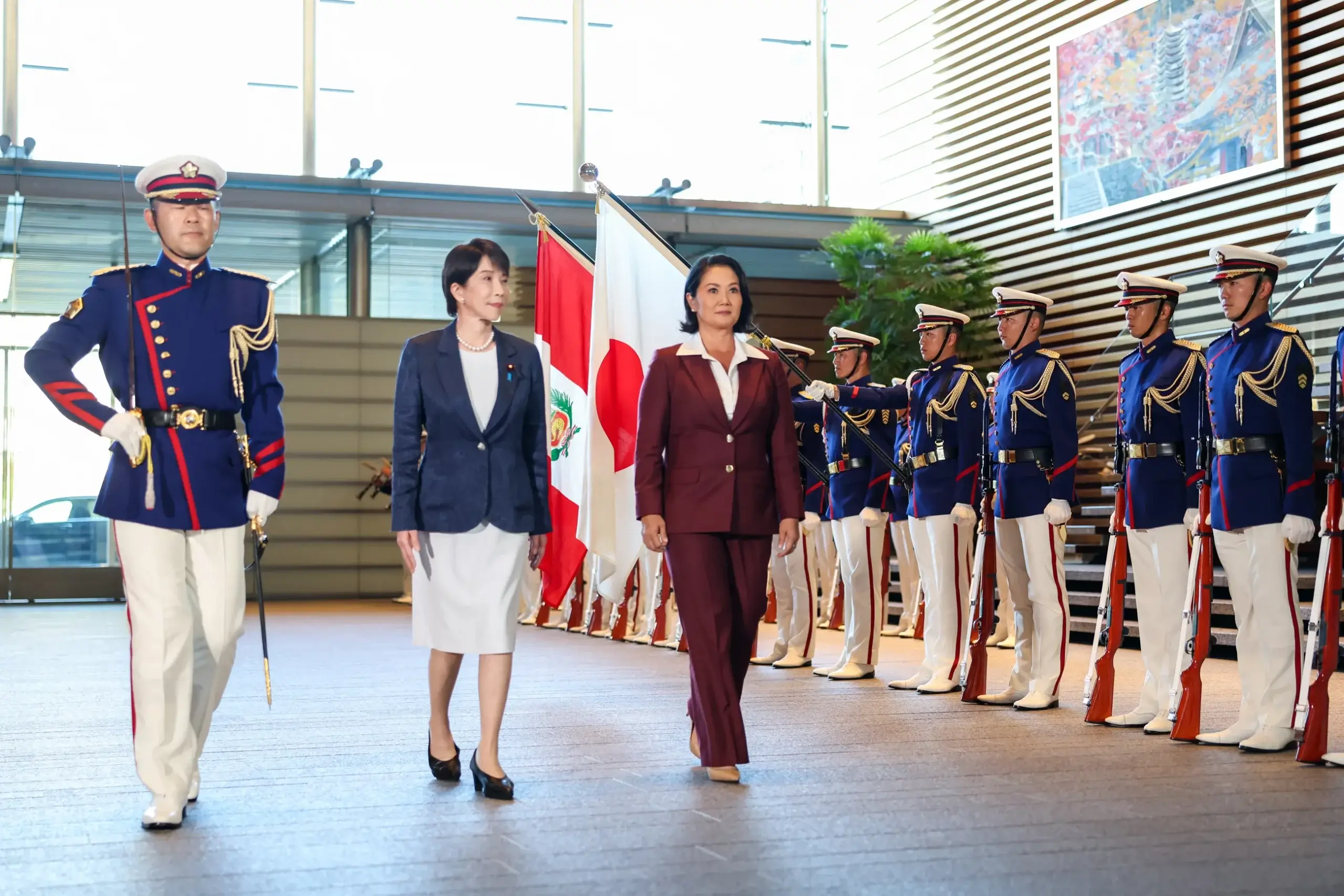
Bogotá, Colombia – Peruvian President Keiko Fujimori and Japanese Prime Minister Sanae Takaichi agreed to strengthen bilateral cooperation in critical mineral supply chains during a meeting in Japan on Friday.
Japan has been pursuing new sources of rare earth metals since Beijing reduced exports to Tokyo in January after Takaichi expressed support for Taiwanese sovereignty.
The agreement comes amid a global scramble for critical minerals, with experts saying Peru – which is home to vast supplies of metals like copper, zinc, and molybdenum – is maintaining a neutral stance.
Fujimori landed in Japan on Thursday after attending the APEC Summit in Shenzhen, China, earlier this week.
On Friday, she met with her Japanese counterpart to discuss trade, investment, energy, and disaster relief – something particularly pressing as Peru braces for the ‘super’ El Niño weather phenomenon.
Following the meeting, the two right-wing leaders announced their intention to boost economic cooperation and create more resilient supply chains.
“We will work together to maintain and strengthen a free and fair economic order based on rules,” said Takaichi.
The two governments signed three memorandums of understanding, covering foreign investment, energy, and rare earth metals.
Peru is rich in critical minerals like copper, which are essential to Japanese manufacturing in industries like electric vehicles and renewable energy.
Friday’s mineral agreement may also be politically beneficial for Peru, according to Martin Cassinelli, Associate Director at the Atlantic Council’s Adrienne Arsht Latin America Center.
“With prominent investments by China in the mining space raising concerns in Washington, for Peru to be able to welcome an additional source of investment from Western countries is a good thing,” he told Peru Reports.
The United States and China are engaged in a global competition for control of critical minerals and Latin America’s resource-rich middle countries have proven a key battleground.
Peru is economically dependent on China, which is its primary trading partner and export destination as well as a key source of foreign investment. At the APEC Summit, Fujimori was warmly greeted by Chinese President Xi Jinping, who pledged US$22.5 million in disaster assistance to Peru for El Niño.
But as Cassinelli notes, Lima must also keep the White House happy: “Washington is a relevant political and military ally, and it cannot afford to sour relations with Washington.”
He argued that Peru would benefit from working with both nations, a strategy employed by many Latin American nations.
“It is in the Peruvian state’s interest not to fence out the other superpower and make the case for a positive-sum, rather than a negative-sum game,” the analyst concluded.
Featured image description: Peruvian President Keiko Fujimori and Japanese Prime Minister Sanae Takaichi in Japan.
Featured image credit: @takaichi_sanae via X